Building Formalization Infrastructure for Patents
Bringing compiler-grade verification to patent law.

PUBLISHED
AUTHOR

Angela Gao
Co-Founder & CTO
Building Formalization Infrastructure for Patents.
AI has made remarkable advancements in domains with verifiable outputs, like coding and math. That progress rests upon decades of formalization infrastructure—compilers, type checkers, proof assistants—that can mechanically confirm whether an output is correct. Patent law has had no equivalent, until now.
What exactly is a patent?
Building AI for patents is uniquely difficult, and understanding why requires understanding what a patent actually is.
Patents are composed of 2 parts: the claims and the specification. The claims define exactly what the invention is and what the patent protects. The specification acts to support the claims by providing background, figures, and additional details.
The claims are the operative part of any patent. Writing claims is, in many ways, much closer to writing C than to writing prose. The key features of an invention are assembled into claims by declaring features as variables and composing them into claims that match the semantics of the invention. The variables in a patent can be thought of as terms, which are declared, referenced, and operated upon with the same structural logic you would find in a computer program. Just like with C, claims either compile or don’t, and even a single defect can be catastrophic. When a patent is submitted, patent examiners, whether they realize it or not, review the patent in the same way a programmer traces through variables in code. The examiners evaluate whether each variable was properly declared, used consistently, and adequately supported by the specification.
Building formalization infrastructure for patents.
Just as an IDE can trace every variable reference across a codebase, patents require infrastructure to trace the internal logical structure end to end. Our neurosymbolic system is engineered in-house and provides patent language with the verifiable structure code has always had. Fearn’s deterministic reasoning allows our AI to flag uncertainty, build verifiable reasoning, and guarantee correctness.
Our models trace terms across claims and specifications just as an IDE traces variables through source code. This lets us verify the provenance of every reference and flag inconsistencies before they become vulnerabilities. Our infrastructure empowers anyone to build, validate, and understand a patent with the same rigor that a patent attorney reviews a patent.
Pushing the Pareto frontier for patent law.
We benchmarked our models against state-of-the-art frontier models, across a suite of patent understanding tasks. To make this benchmark meaningful, we focused on tasks with verifiable answers. Each task required clear answers that were either binary, or could be defined with a quantifiable rubric, as opposed to tasks requiring arbitrary expert judgement.
The patent understanding tasks we benchmarked include: understanding term references across the claims and specification, contextualizing figures with the relevant patent sections, and analyzing how different parts of the invention disclosure are supported. We evaluated patents across multiple technical domains, each with a context spanning up to 250K tokens, not including the patent figures which add to the model’s context window.
Our models produce 10x fewer errors at 5x the speed when compared to frontier models including ChatGPT 5.5, Claude Opus 4.7, and Gemini 3.7 Pro. The results below show model performance relative to latency. The most common errors in competing models were antecedent basis errors and hallucinations. To test hallucinations, we explicitly queried about figures and claims that were not present in the text to measure fabrication rates.
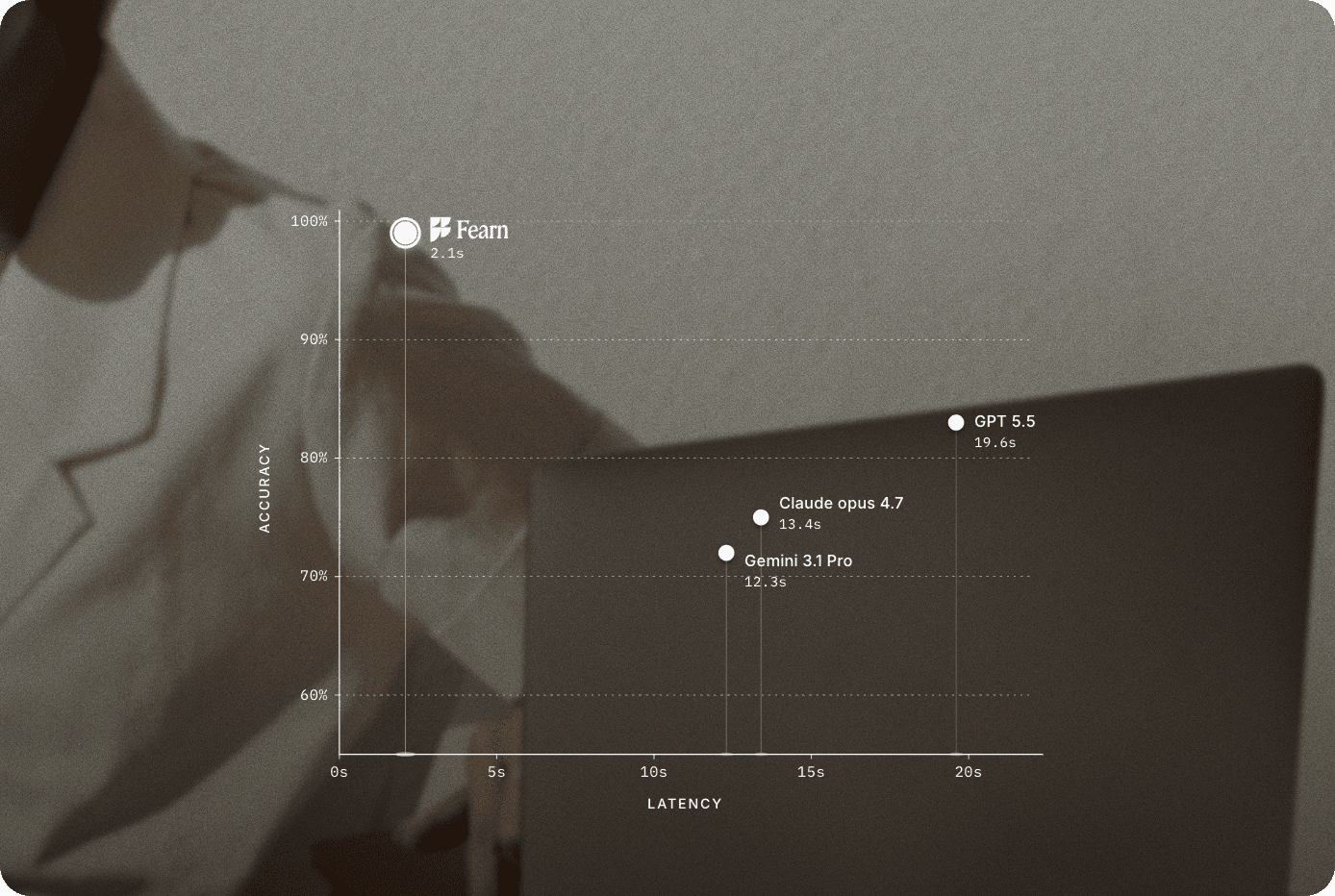
Strong performance here is not just a function of better context handling. It comes from our ability to verify and validate outputs, something that general purpose LLMs have no mechanism to do.
Built private by design.
That same architecture that allows for formal verification also allows for a fundamentally different deployment model.
Our neurosymbolic approach orchestrates a suite of specialized small models for both drafting and patent analysis. Our outputs are reliable and deterministic, not stochastic approximations of correctness. Because we build, deploy, and serve our models, we guarantee that your documents never leave our infrastructure.
For IP work, where confidentiality is as important as accuracy, this matters.
We believe the frontier for reliable AI systems for patents is empowered by building the formalization infrastructure that guarantees correctness. If you want to draft patents you can actually understand, try Fearn.